Ikan Aneh Hidup di Limbah Beracun


Scientists discovered a strange fish that live in the waters of the most severely affected by pollution. The fish managed to survive because it has evolved to be able to cope with hazardous chemicals.
The 'explorers poison' the world's water is tomcod fish, which look similar to regular cod. The difference is, the size of fish that live in the Hudson River and surrounding area has a size smaller.
For information, since 1947 until 1976, companies like General Electric have been washed away PCBs and dioxin into the river in the vicinity of Hudson. In the 1980s, about 95 percent of fish in the area was found suffering from liver tumors.
"Apparently, the more we studied, the more we found the fish that are resistant to PCBs and dioxins," said Isaac Wirgin, toksikolog from New York University, as quoted from Science, February 19, 2011.
From further study, researchers concluded that in some fish, pollutants have entered the cell nucleus. Pollutants that then had disrupted the DNA from particular genes that make the fish suffer from diseases.
By coincidence, tomcod have a gene that is able to tolerate PCBs and dioxins. Thus, fish that have these genes will survive better than other fish.
Technically, tomcod is not a mutant. Chemicals group to attack only certain fish, while they can survive. Even so, there remains a negative impact.
"Generally, levels of PCBs or dioxin like this will kill the organism," ata Wirgin. "However, here they survive and become food for other living things," he said.
Wirgin mention, fish or other creatures that eat tomcod will absorb pollutants that is not necessarily to be borne by the genes of their bodies.
Furthermore, although managed to evolve to be able to survive against pollution, these fish have lost the ability to cope with natural disturbances. "For example, as the condition of decreased oxygen in the water or rising water temperatures," says Wirgin.


Translated From VIVAnews

The World Seven Miracle


A group of Geography students are studying "The World Seven Miracle" at the beginning of the lesson. They were asked to make a list of "what they think" is the "Seven Wonders of the World" at this time. Although there were some disagreements most votes:

* Egyptian Pyramids
* Taj Mahal India
* Wall of China
* Tower of Pisa Italy
* Temple of Angkor Wat
* Eiffel Tower
* Parthenon Temple


When collecting a list of choices the teacher noticed a student is quiet, not to collect the paper work. So, the teacher asked him if he has trouble with her list.

The girl replied, "Yes ma'am, a little. I can not because there were so many. " The teacher said, "Well, tell us what you have and maybe we can help." The girl hesitated, then read, "I think the seven wonders of the world are:

* Can see
* Can hear
* Can touch
* Can love


Hmmm, he thought for a moment then continued,

* Can feel
* Can laugh
* And can love


The classroom was silent at once. How easy it is for us to see the exploitation of man and called him "Miracle". While we see again all that God has blessed to us and we call it the "Ordinary". Hopefully today you are reminded all too well the magic thing in your life.
 
Translated From : WikiMu

10 Scientific Facts That You Don't Know About Earth


We have been living on Earth. The only planet - from 9 planets that are members of the solar system - which is known to be eligible for life, with a weight of 66 sextiliun (1.000.000.000.000.000.000.000 or 10 ^ 21) tons and 1 trillion cubic kilometers in volume. But have you know the earth is more distant?
Below are 10 facts about the Earth that you might never know. Hopefully useful as an addition to your knowledge.

1. Earth's surface is more subtle than billiard balls
If the Earth depreciated to about the size of a billiard ball, the surface will be smoother than the surface of the billiard balls. Is this true? Let us look further, to the count of the smallest in mathematics.
First of all, how gentle a billiard ball? A billiard ball with diameter of 2.25 inches or about 5.7 cm, and has a tolerance of approximately 0.005 inches or 0.013 cm. In other words, the ball should not be experiencing stress or conflict of more than 0.005 inch or 0.013 cm in its highest position. That's really soft. The ratio of the size of a collision is allowed compared to the size of the ball is 0.005 / 2.25 or about 0.002.
Now we compare with Earth ball. Earth has a diameter of about 12.735 kilometers (on average). By using the comparative subtlety of billiard balls on top - or the Earth is considered as a billiard ball - if no collision (mountains) or pressure (rivers) more than 12.735 miles x 0.00222, or about 28 km in actual size.
Known to the highest point on Earth's surface is the summit of Mount Everest is about 8.85 kilometers, and the Marianas Trench, the deepest point is about 11 km. The figures are still far within the limits of tolerance, which is 28 km. So it has been proven to Earth's surface smoother than a billiard ball.

2. Earth is not round
In general, note that the Earth is round like a ball from thousands of years ago. Eratosthenes even calculated the circle with incredible accuracy!
But it was not as perfect as that. Earth rotates on its axis, and as a result the earth became swollen due to centrifugal force, a force pushing out that you also experience when you are riding in a car that turned left suddenly. Because the rotation of Earth, appears a force out that the maximum in the Earth's equator, making the lumps out in areas such as basketball Katulistiwanya occupied. This form is called a ball with bumps transverse (oblate spheroid).
If you draw a line from north to south pole of Earth, Earth's diameter is 12,713.6 km. If you measure the diameter of the equator as the margins, the length is 12756.2 km, where there is a difference of about 42.6 kilometers. That exceeds the tolerance in billiard balls. So the Earth is softer than billiard balls, but not sebulatnya, had understated the size of Earth.
3. Earth drawn here and there
But pemasalahan not finish up there. Earth also experienced a bruised due to the Sun and Moon. Sun and Moon has a gravitational pull that Earth's pull. As a result there bumps on the surface of the Earth - both on land and at sea - the section closest to the Sun and Moon. The increase or lump due Moon has gravity amplitude (height) with a rough estimate of 1 meter in the water - so-called high tide, and perhaps about 30 cm in the soil. Sun are much bigger than the Moon, but because it is so far away then the resulting increase of about half of it. This is much smaller when compared with the deviations due to the rotation of the earth, but still there.
4. Earth is not really aligned with its geoid If the Earth has infinite elasticity, and the circumstances that the Earth responds by not limited to any pressure, so the shape becomes a strange and distorted (highly elastic gel-like), that's called the geoid. For example, if the entire Earth's surface is water completely - if global warming has resulted in very severe - then the form will be geoid surface. But the continents do not see regularly, so that the surface of the Earth is only approximately a geoid.
Precise measurements of the earth's surface are calibrated against this geoid, but the geoid itself is hard to measure. The best thing we can do now is take the model by using complicated mathematical functions. That is why ESA launched a satellite named Goce (Gravity field and steady-state Ocean Circulation Explorer) on 17 March, to directly determine the geoid's shape.
5. Jumping into the holes that penetrate into the Earth as it tries to orbit into space
We wished to dig a hole through the Earth which berkedalaman 13,000 km, and travel to the center of the Earth. What happened? Whether we can cross the center of the earth and out to the surface of another?
First of all, you will experience continuous acceleration when falling towards its center as drawn, with a total travel time approximately 20 minutes to get there. However, when you try to pass through the center of the Earth to rise to the surface, you will begin to slow and eventually will fall back to its center. Whatever you try will certainly fall, because gravity center of the earth when you were growing increasingly distant from the center point, and acceleration due to gravity is reduced when approached. The speed you need to get past the center point and up to the surface of the earth is about 7.7 km / sec.
In fact, mathematical calculations that control the same movements at the time of orbital objects. The time needed to fall to Earth the same as those needed to return to orbit, if the orbital is really on Earth's surface (orbits slow down as the orbital diameter bigger). Even that strange, it does not matter where you start from the hole, a straight line through the Earth from any point toward the other point (the shortest distance, through the center line of the earth, or elsewhere) to give you time-travel the same, ie 42 minutes or about it.
6. The depth of the earth which affects the heat shrinkage, the surface of the sink, and radioactive decay.
In the past, you, me, and everything on Earth was scattered in a disk around the Sun several billion kilometers. From time to time, all this strewn collected into planetesimals, such as small asteroids, which hit at the same time, some elongated, shaped larger. In the end, after this thing is big enough, then the active pull of gravity with the other. Together, they release kinetic energy in the form of heat, and the young Earth tangible ball that melts. Presto! A heat source appears. With increasing gravity, the force trying to destroy the Earth to form a more solid ball. As you squeeze a hot object. Presto! The second heat source is created.
Since the Earth is still liquid, heavy materials fall to the center and lighter material ejected upward. So the Earth's core contains iron, nickel, osmium, and various other metals. As this material falls, heat is produced, then the potential energy is converted into energy of motion, which is then converted into thermal energy separately.
And most of the heavy elements are radioactive, like uranium. When the proceeds, releasing heat. The calculations are probably more than half of the heat inside the planet.
So the Earth gets hot in them because there are at least four sources. And still hot until now because of earth's crust to be a good insulator. The Earth's crust to prevent heat from escaping efficiently, even after a period of 4.55 billion years of the earth is still a warm place that is not fun.
Sometimes, the amount of heat that flows out onto Earth's surface from an internal source of approximately 45 trillion Watts. About three times the global human energy consumption. If we can keep all the heat and convert it with 100% efficiency in the form of electrical energy, means literally the energy for all mankind. But unfortunately, it can not be done.
7. Earth has five "months" other.
We all know that the Earth has a moon only. But did you know there are four other objects, at least, which is very close to Earth in our solar system. They are not really the moon, but much like the moon.
The largest named Cruithne. The distance is about 5 kilometers from Earth, and has an elliptical orbit that is, a time inside and outside the Earth's orbit around the sun. Cruithne orbital period is about Earth's orbital period, and because the strangeness of this path, then he is always on the same side to Earth from the Sun. From our perspective, it makes a weird form of orbit, sometimes closer, sometimes farther from Earth, but never really far away.
That's why some people say this thing as a "month" of the Earth. But Cruithne actually orbits the Sun, so that is not Earth's moon. Just as the three other objects were found. But "few months" will not harm the Earth, even if they are near the Earth, but their orbits do not physically pass through it. So the Earth remain safe from them.
8. Earth would be a more giant
We may still be safe from collision Cruithne, but space is still littered with many ruins, and the fact that the Earth cuts a wide area of about 125 million square kilometers. When we navigate this material, we accumulate on average 20-40 tons of material per day! Most of tangible dust particles so small that burned down in Earth's atmosphere, such as what is called a meteor. This meteor fragments eventually falling to the ground after being taken by the rain and buried, the river and then drift into the ocean.
40 tons per day may sound like a lot, but it only 0.000000000000000000000002% or 2 × 10 ^ -23 times the mass of the earth. In other words required about 140,000 million trillion years to double the mass of the Earth, then in one year was enough cosmic junk material to fill a full six-storey building.
For the record the Earth is also losing mass, because the atmosphere had a leak due to various different processes. Though still much slower than the increase in mass accumulation, so that its influence remains will double its mass.

9. Mount Everest is not the biggest mountain
The height of a mountain probably has an obvious definition, but would be more accurate if measured from the bottom to the peak point kulminasinya. Mount Everest stretches 8850 meters above sea level, but that from the point first to the general limitation of the Himalayas. Volcano Mauna Kea, Hawaii, 10,314 feet from end to end, although only reaching 4205 meters above sea level, but it is a bigger mountain than Everest.
10. It's not easy to destroy Earth
Maybe you've heard about various ways the destruction of Earth, but actually it is not easy to destroy the Earth.
Let's take the example of the destruction of the evaporating planet. Views of Earth by evaporation like blowing hard, are scattered and can not go back even though there is gravity. How much energy is required, if it is done?
Suppose we take a stone. Upward with a strong throw to the air to escape from Earth. And it will take a lot of energy! Now do continue, once again, kept repeating itself, around 10 ^ 15 times, until the entire Earth down. It takes so much energy! But there are advantages, every stone that we release will reduce the bit gravity of Earth - because the mass of Earth will shrink a rock mass. When gravity is reduced, it means that much easier the next throwing stones into the sky.
Mathematical calculations to calculate how much energy it takes to throw a rock simultaneously, covering also decrease the Earth's gravity. If you make some basic assumptions, the energy required is roughly 2 x 1032 Joules, or 200 million trillion trillion Joules. Quite a lot. For comparison, the number was equal to the sum total solar energy emitted during the week. It is also comparable with trillions of times the destructive energy than all nuclear weapons on Earth.
If you want to vaporize the Earth with nuclear weapons, and blow up a number of all existing nuclear Earth in every one second, then takes 160,000 years to turn the Earth into a gas. And that if you only consider the factor of gravity alone! And there chemical bond energy in the earth, the mutual binding between the material, so it will need another energy.
Even major clashes can not vaporize the planet. A Mars-sized object hit the Earth more than 45 billion years ago, and the remains then fabricated and formed the moon, but Earth still does not evaporate. Even hitting a whole planet into another planet would not destroy it! Of course, the collision of the Earth will reach a molten core, so that permanent damage occurs. But Earth is still there.
Even if the sun will become a red giant, but still not be able to swallow the Earth, would only be harmful to humans only. But the total evaporation will not occur. Because the planets tend to survive, and will remain a safe place to live

 
Source article: http://www.bspcn.com/2008/09/09/10-things-you-don% E2% 80% 99t-know-about-the-earth /
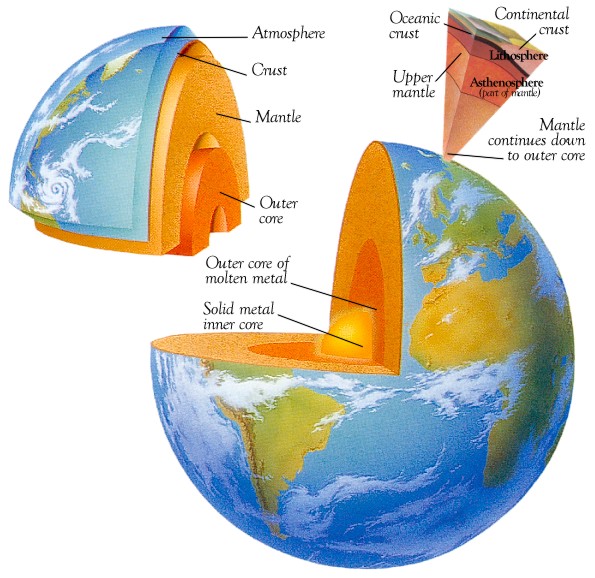
Source image: http://pr4s.files.wordpress.com/2007/09/struct2.jpg

Various Benefits of Cherry Trees


The tree has been outstanding for more than 19 years since I have not entered kindergarten until now where I've worked at age 26 years, the tree still stands firmly beside the mosque near my house. First in a small time, me and my friends like to climb this tree and make it as a tower monitor when we play at war, because in addition to lush making it suitable as a place to hide, this tree also has a small red fruit that tastes very sweet.
Cherry tree its name, in Jakarta, better known by the name of the cherry tree or talok. This tree has several names in other countries like in Malaysia kerukup known as Siam, the Philippines was named datiles, aratiles, or manzanitas. In Spain capulin known as blanco, cacaniqua, nigua, niguito, in England called the Jamaican cherry, Panama berry, cherry or Singapore. While the Latin name of this tree is Muntingia calabura L. Not the kind of cherry tree native to Indonesia, this tree comes from the Latin American region such as southern Mexico, the Caribbean, Central America to Peru and Bolivia, in the late 19th century cherry tree is brought into the Philippines, then quickly spread throughout the tropical regions of Southeast Asia whether it is carried by humans and is carried by animals who eat them.
Cherry tree is not a tree that can grow tall and large, a maximum of only 12 meters tall, but this tree has a canopy width and is usually used as a roadside tree. In addition, in some places the wood used as firewood due to its wood is soft and easy to dry. The bark is easily peeled used as rope and cloth napkins. The leaves also can be used as a kind of tea and used by people in Peru as a traditional medicine headache and anti-inflammatory, in Indonesia cherry fruit traditionally used to treat gout cherry fruit by consuming as many as 9 points 3 times a day it is proven to reduce pain disease arising from uric acid. Cherry is very popular in Mexico, which sold in large quantities in the traditional markets, cherry fruit can also be preserved and made jam as in Sri Lanka.
Cherry tree fruit other than humans is a preferred food for birds and bats. From my monitoring of some birds who like to eat fruit is the bird cherry tree Chili Java (Dicaeum trochileum) a small bird with a size of 8 cm, the male has a red color from head to chest, body colored light gray, black wings and beak while the female body part top while the bottom is brown colored light gray. In addition to Java Chili other birds are fond of this tree eating fruit is Merbah cerukcuk (Pycnonotus goiavier) cousin finch has characteristics similar to the finches are brown wings, gray body with yellow at the bottom of the tail, only the head are different, if the finch has a black head, merbah cerukcuk have characteristics in the eyes of crested and brown stripes. To bat species that often eat the cherry fruit is Krawar Flying-Fox (Cynopterus brachyotis).
These animals take part and help spread seeds of cherry trees to various places, usually because the bird Chili cerukcuk Merbah Java and will take the fruit of cherry and then blackmailed to take the contents of which are in fruit, fruit seeds are not digested in the stomach will be wasted together dirt and grow in locations distant from the parent tree. As with bats, inedible fruit seed attached to the body of the bat when the bat then wash the seeds fall to the ground.
As a result of actions the animals can grow cherry seeds everywhere depending on bird and bat it down where, could be grown in a ditch, river, side of the house and because of the kinds of fruit-eating animals is also a common animal in urban areas such as city of Jakarta, the cherry trees were encountered at the corner-corner of the city of Jakarta and make cherry tree as one of pioneer plants that most often found in human residential areas in the tropics.
So many benefits from a cherry tree in the filling dynamics of life in this world. So is there any cherry trees around your home?
(Adapted from various sources)
Translated from Wikimu

10 Benefits of Smoke for Human Health


You definitely surprised when I read the title of this news. Just like my surprise when I first read from the source. [1] I am aware of negative information about smoking and smoking habits already crammed to us long ago. Most link the adverse effects of cigarette smoke and substances contained therein on the health of the human body. Information is received by the wider community that lay on the research and study as absolute truth that does not need to be debated.
But not so with the scientists. In accordance with the field of science they conduct research about the impact of smoking and smoking for health with the departure from a neutral premise. They tried to dig there any benefits of the substances contained in a cigarette to human health, which has already given the widespread negative stigma.
This news certainly did not intend to invite you to start smoking or continue your habit of sucking smoke tobacco. But it is your right to believe or not that nicotine and other substances which are also derived from nature and are in cigarettes also have utility.
Here's some research that reveals the benefits of smoking to human health. I am not a doctor or a researcher in health, so the scientific discussion about the contents of this news could be debated by the experts themselves.
 
1. Smoking Reduces Risk of Parkinson's
Much evidence suggests that smoking against Parkinson's disease. A new study adds strong evidence that reported previously that smoking may protect humans from Parkinson's disease. In particular, new research shows the temporal relationship between smoking and reduced risk of Parkinson's disease. This means that a protective effect against Parkinson reduced after smokers stop smoking. [2]
Other studies regarding the positive effects of smoking on Parkinson Desease (PD) is a study of 113 male twin pairs. The research team led by Dr. Tanner continues to see significant differences when the dose was calculated to 10 or 20 years before diagnosis. They concluded that these findings refute the claim that people who smoke tend to have PD. [3] There are many other studies on smoking habits are useful against Parkinson's. [4]
2. Smokers are more powerful and speedy recovery from heart attack and stroke
Another large study showed the benefits of smoking, the benefits of restenosis, or narrowing of blood vessels that cause blood flow to be limited, such as blood vessels to the heart (cardiovascular disease) or to the brain (stroke) Smokers have a better chance of survival and healing more fast. [5]
Other studies mention krbon mnoksida can reduce heart attacks and strokes. Carbon monoxide is a byproduct of tobacco smoke. A report shows very low levels of carbon monoxide to help the victims of heart attacks and strokes. Carbon monoxide inhibits blood clotting, which dissolve dangerous clots in the arteries. The researchers focused on the close resemblance between the carbon monoxide with nitric oxide that keeps blood vessels dilated and prevent the buildup of fixed white blood cells. Recently, nitric oxide has enhanced the status of regular air pollutants become the second most important physiological link internally. It is therefore not surprising that carbon monoxide would be paradoxical to save the lungs from injury due to blockage of blood vessels to the heart (cardiovascular blockage). [6]
3. Smoking reduces the risk of gum disease severe shrinkage First mentioned that tobacco is the root of all problems of the teeth and mouth disease. Whereas one study showed that smokers actually had a lower risk of gum disease. [7]
4. Smoking prevention for asthma and other allergic diseases A study of two generations of Swedish residents indicated in the multi-variation analysis, some children of mothers who smoked at least 15 cigarettes a day tended to have lower chances to suffer from allergic rhino-conjunctivitis, allergic asthma, atopic eczema and food allergy, compared with child- children of mothers who never smoked. The children of fathers who smoked at least 15 cigarettes a day had the same tendency. [8]
 
5. Nicotine kills germs that cause tuberculosis (TB)
One day Nicotine may be an alternative that surprising as a hard drug treated tuberculosis, says a researcher from the University of Central Florida (UCF). These compounds stop the growth of TB germs in a lab test, even when used only in small quantities, said Saleh Naser, an associate professor of microbiology and molecular biology at UCF. Most scientists agree that nicotine is a substance that causes people to become addicted to cigarettes. [9]

 
6. Smoking is a rare skin cancer prevention
A researcher at the National Cancer Institute believes that smoking can prevent the development of skin cancer that afflicts mainly the elderly in the Mediterranean area of Southern Italy, Greece and Israel. Not that smoking is recommended for this population, said Dr. James Goedert, but the important thing is smoking tobacco may help to prevent a rare form of cancer. And this is a recognition of researchers at the National Cancer Institute that there are benefits from smoking. [10]

 
7. Smoking reduces breast cancer risk A new study in the journal of the National Cancer Institute (May 20, 1998) reported that a certain gene mutation carriers (which tend to be carriers of breast cancer), who smoked for more than 4 pack-year (ie, number of packs per day multiplied by the total duration of smoking ) according to statistics was significantly decreased by 54 percent in the incidence of breast cancer compared with carriers who never smoked. One of the strengths of this study is that the decline in the incidence of exceeding the threshold of 50 percent. [11]
8. Nitric Oxide in reducing nicotine colitis
Nicotine reduces the circular muscle activity, particularly through the release of nitric oxide, in the case of ulcerative colitis (UC) or inflammation of the intestine. These findings may explain some therapeutic benefit from nicotine (and smoking) to UC and to explain about the driving colonic dysfunction in active disease. [12]

 
9. Effects of transdermal nicotine on cognitive performance (thinking) people with Down Syndrome A study on the effect of nicotine-agonist stimulation with 5 mg of skin tissue implants, compared with placebo (drug control), on cognitive performance in five adults with the disorder. Improvements may be related to attention and information processing seen in patients with Down Syndrome compared to healthy controls. [13]
Down syndrome is a disease caused by abnormalities in chromosome 21 at band Q22 SLC5A3 gene, which can be recognized by looking at a fairly typical clinical manifestations. Disorders that affect the physical growth and mental retardation of children was first recognized in 1866 by Dr.John Longdon Down. [14]
10. Smoking is good for pregnant women to prevent hypertension in pregnancy and maternal-child transmission of Helicobacter pylori infection The concentration of urinary cotinine (tobacco bermetabolis in the body) confirmed reduced risk of preeclampsia with tobacco exposure Exposure. Preeclampsia is a medical condition where hypertension appears in pregnancy (pregnancy with hypertension) in collaboration with a large number of proteins in the urine. This study, although small, shows one benefit of smoking during pregnancy. "These findings, obtained by using laboratory tests, confirmed the decreased risk of developing preeclampsia with tobacco exposure (Am J Obstet Gynecol 1999;. 181:1192-6.) [15] Another study found a strong inverse association between maternal smoking mothers and Helicobacter pylori infection among preschool children, which indicated the possibility that the mother-child transmission of infection may be less efficient if the mother smokes. To evaluate this hypothesis further, conducted a population-based studies in which infection of H. pylori was measured by 13C-urea breath test (urea content in the breath test) in 947 preschool children and their mothers. We obtain detailed information about potential risk factors for infection, including maternal smoking, using standard questionnaires. Overall, 9.8% (93 of 947) of the children and 34.7% (329 of 947) of the mothers had been infected. Prevalence (the ratio of the number of disease events with units in the population at risk) of infection is much lower among children of uninfected mothers (1.9%) than in children of infected mothers (24.7%). There is a strong inverse relationship of infection of children with mothers who smoked (adjusted odds ratio or deviation = 0.24; 95% confidence interval = 0.12 to 0.49) among the children of infected mothers, but not in among the children of infected mothers. These results support the hypothesis of a major role for maternal-child transmission of infection H. pylori, which may be less efficient if the mother smokes. [16]
Perhaps you suspect that research is funded by tobacco companies. But research is never published widely, if it aims to support the promotion of cigarettes. While scientific information on hazards of smoking is very dominant. Actually this is the anti-smoking propaganda that need to be suspected as an effort to boost sales of drugs from pharmaceutical companies. Wallahua'lam.


Source :
[1] http://www.forces.org/evidence/evid/therap.htm
[2] http://www.data-yard.net/10v2/parkinson.htm
[3] http://www.ncbi.nlm.nih.gov/pubmed/11865136
[4] http://www.forces.org/evidence/carol/carol36.htm
[5] http://85.18.251.150/34/circulation_2001_104_773.htm
[6] http://www.data-yard.net/10b/cm.htm
[7] http://www.data-yard.net/10o/gums.htm
[8] http://www.data-yard.net/30/asthma.htm
[9] http://www.data-yard.net/10c/nicotine.htm
[10] http://www.data-yard.net/10b/kaposi.htm
[11] http://www.forces.org/evidence/files/brea.htm
[12] http://www.data-yard.net/22/ncbi.htm
[13] http://www.data-yard.net/13/tlj.htm
[14] http://id.wikipedia.org/wiki/Sindrom_down
[15] http://www.data-yard.net/2/13/ajog.htm
[16] http://www.forces.org/evidence/evid/preg.htm

Translated From : Wikimu

Copyright in TL Undip 2010. Powered by Blogger.